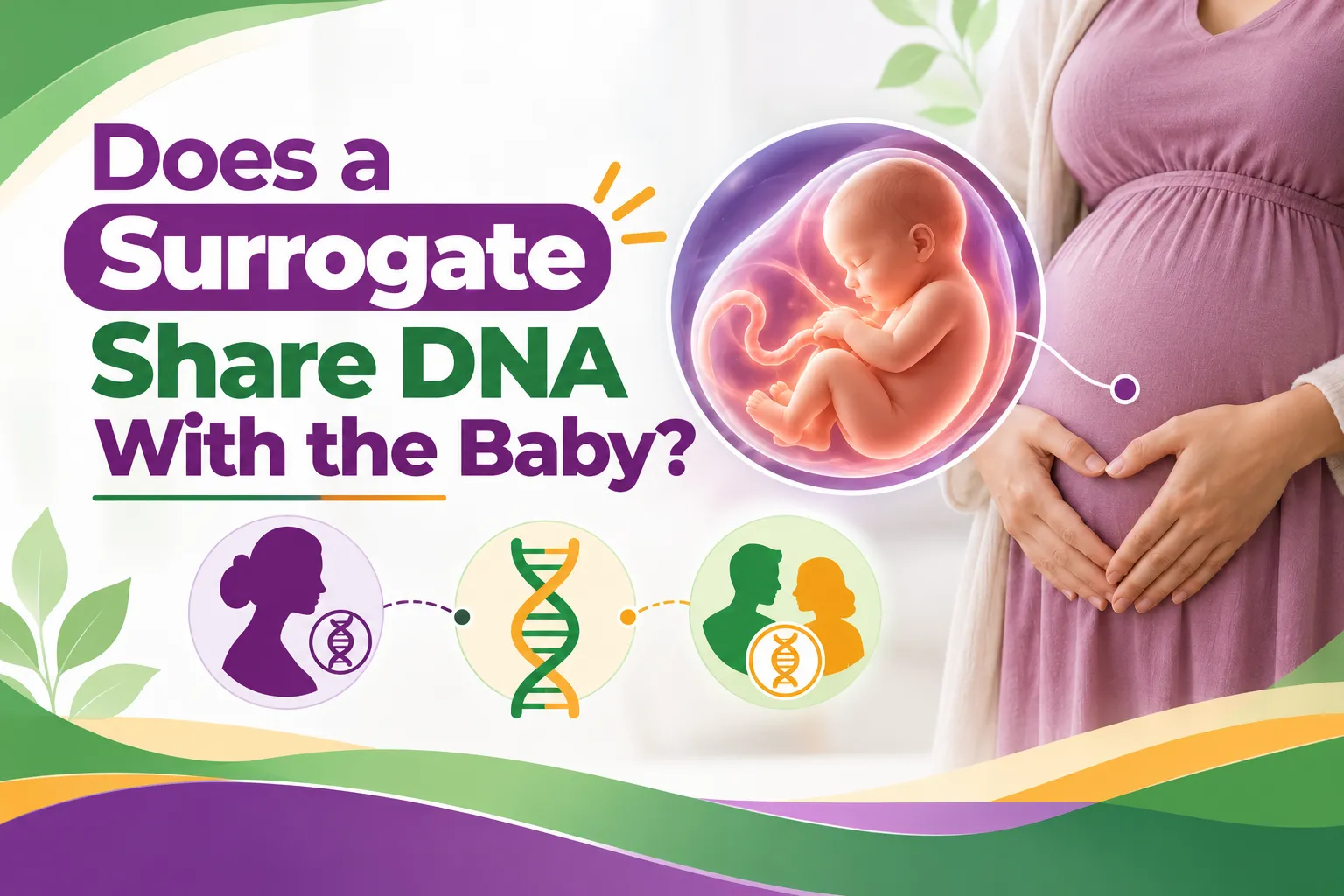
Whether a surrogate shares DNA with the baby depends on the type of surrogacy. In gestational surrogacy, the surrogate carries an embryo created through IVF using the egg and sperm of the intended parents or donors. Since the surrogate’s own egg is not used, she does not share DNA with the baby. In contrast, in traditional surrogacy, the surrogate’s own egg is fertilized, usually through artificial insemination, making her the biological mother and meaning she shares approximately 50% of the baby’s nuclear DNA.
Does a Surrogate Share DNA With the Baby?
In gestational surrogacy, the surrogate does not contribute her own egg to create the embryo and therefore does not share inherited DNA with the baby. The embryo is created through in vitro fertilization (IVF) using an egg and sperm from the intended parents or eligible donors, as permitted by applicable law.
The baby inherits its genetic material from the egg and sperm providers, while the gestational surrogate carries the pregnancy and supports the baby’s development in her uterus.
However, the genetic and gestational roles can differ depending on the type of surrogacy. In traditional surrogacy, the surrogate’s own egg is used, making her genetically related to the baby and contributing approximately 50% of the baby’s nuclear DNA.
How Does Genetics Work in Surrogacy?
Genetics is a scientific concept that describes how an individual acquires his/her genetic information from the parents through the egg and the sperm cells.
Gestational surrogacy involves the following process:
Egg: Contains half of the baby's genetic material in the nucleus.
Sperm: Has the other half of the baby's nuclear genetic material.
Embryo: The product of combining the egg and the sperm cells through in vitro fertilisation.
Surrogate: Bears the embryo in her womb.
The genetic information of the surrogate mother does not form part of the baby's genetic information even though the surrogate bears the pregnancy. However, the conditions prevailing in the womb during the pregnancy may affect the baby's development.
What Is the Difference Between Gestational and Traditional Surrogacy?
These terms provide insights into whether a surrogate is genetically linked to the baby.
Gestational Surrogacy
In this type of surrogacy, a fertilized egg is placed in a surrogate’s uterus. It is commonly referred to as In Vitro Fertilization (IVF). The egg may be provided by the intended mother or another permitted source, based on the situation.
As the surrogate does not provide the egg, she has no genetic link to the baby via the egg. Traditionally, India has a permissive legal framework for surrogacy, and in case certain eligibility and other conditions are met, it may allow this form of surrogacy.
Traditional Surrogacy
In this type of surrogacy, the surrogate provides the egg and is therefore genetically related to the baby.
This form of surrogacy is not permitted in India under the Surrogacy (Regulation) Act, 2021. Under this Act, a woman is not permitted to provide her own gametes, and therefore all intended parents must comply with India’s laws and regulations pertaining to surrogacy before proceeding to undergo treatment.
Whose DNA Does the Baby Inherit in Surrogacy?
It depends on which egg and which sperm are used to make the embryo. Some examples are:
Both intended parents’ gametes: In this case, the baby has genetic material from both intended parents.
Egg donor and intended father’s sperm: In this case, the baby has genetic material from the egg donor and the sperm provider, if legally permitted.
Intended mother’s egg and donor sperm: In this case, the baby has genetic material from the intended mother and the sperm donor, if legally permitted.
In India, the use of donor gametes in surrogacy is restricted and depends on the applicable rules and medical circumstances. The 2024 amendment provides a limited exception where a District Medical Board certifies that a donor gamete is medically necessary for an intending couple, subject to the requirement that at least one gamete comes from the intending couple. Eligible intending women who are widowed or divorced must use their own eggs and donor sperm.
Can Pregnancy Affect the Baby Without Sharing DNA?
Yes. In gestational surrogacy, although the surrogate does not provide any of her inherited DNA, the pregnancy environment is of significance.
The physical state of the woman carrying the child, including her nutrition status, her hormones, as well as exposure to some substances may affect the development of the fetus. Also, scientists research epigenetics, the science that studies changes in activation or deactivation of genes without altering their DNA sequences.
These factors are not an indicator of DNA incorporation into the genetics of the future offspring of the surrogacy. They allow describing the effect that the pregnancy environment can have on the child's development.
Pregnancy visits and proper nutrition are essential for both the surrogate mother and the developing fetus.
Does the Surrogate Have a Biological Connection With the Baby?
While a surrogate is not genetically related to the baby, there are various biological roles that a surrogate plays during pregnancy. The surrogate’s uterus provides the environment for the baby to implant and grow. A surrogate can give birth to a baby that is not genetically related to her. The placenta provides the route for exchange of various substances between the baby and the surrogate. This biology does not change the fact that a surrogate is not genetically related to the baby, nor does it change the fact that a surrogate does not provide the egg. It is also important to distinguish between being the bearer of a pregnancy and being the provider of genetic material. In the case of gestational surrogacy, the surrogate is not genetically linked to the baby since she doesn't contribute an egg in making an embryo. The genetic link of the baby depends upon the egg and sperm utilized in in vitro fertilization (IVF), while the surrogate plays a role in carrying the pregnancy for you and nurturing the baby. Are you thinking about becoming a parent through surrogacy? At Surrogacy Centre India, we can help you know the procedure, medical criteria, and legal framework that you need to follow. 1. Is there a genetic link between a surrogate and the baby in India? In gestational surrogacy, the surrogate is not genetically linked to the baby as she does not provide the egg. 2. Can a baby get the surrogate mother's genes? In gestational surrogacy, the egg is not transferred to the surrogate, so the baby does not get the surrogate's genes. Relatedness due to the influence of the environment during pregnancy is different from genetic inheritance. 3. Does the surrogate's blood mix with the baby's blood? Usually, the blood of the surrogate and the baby do not mix. The blood of the baby provides all the requirements during the pregnancy and the development of the baby. 4. Is the surrogate mother genetically related to the baby? In gestational surrogacy, the surrogate is not genetically related to the baby, as she does not contribute the egg. 5. Does a baby look like a surrogate mother? The baby gets the physical characteristics genetically from the egg and sperm and not from the woman who carries the pregnancy. 6. Can a DNA test show who the baby's genetic parents are? Yes. DNA tests can show the genetic relationship of a child with the people tested including the provider of the egg and sperm. DNA testing should be done by an appropriate lab when there is a legitimate reason.Conclusion
Frequently Asked Questions