
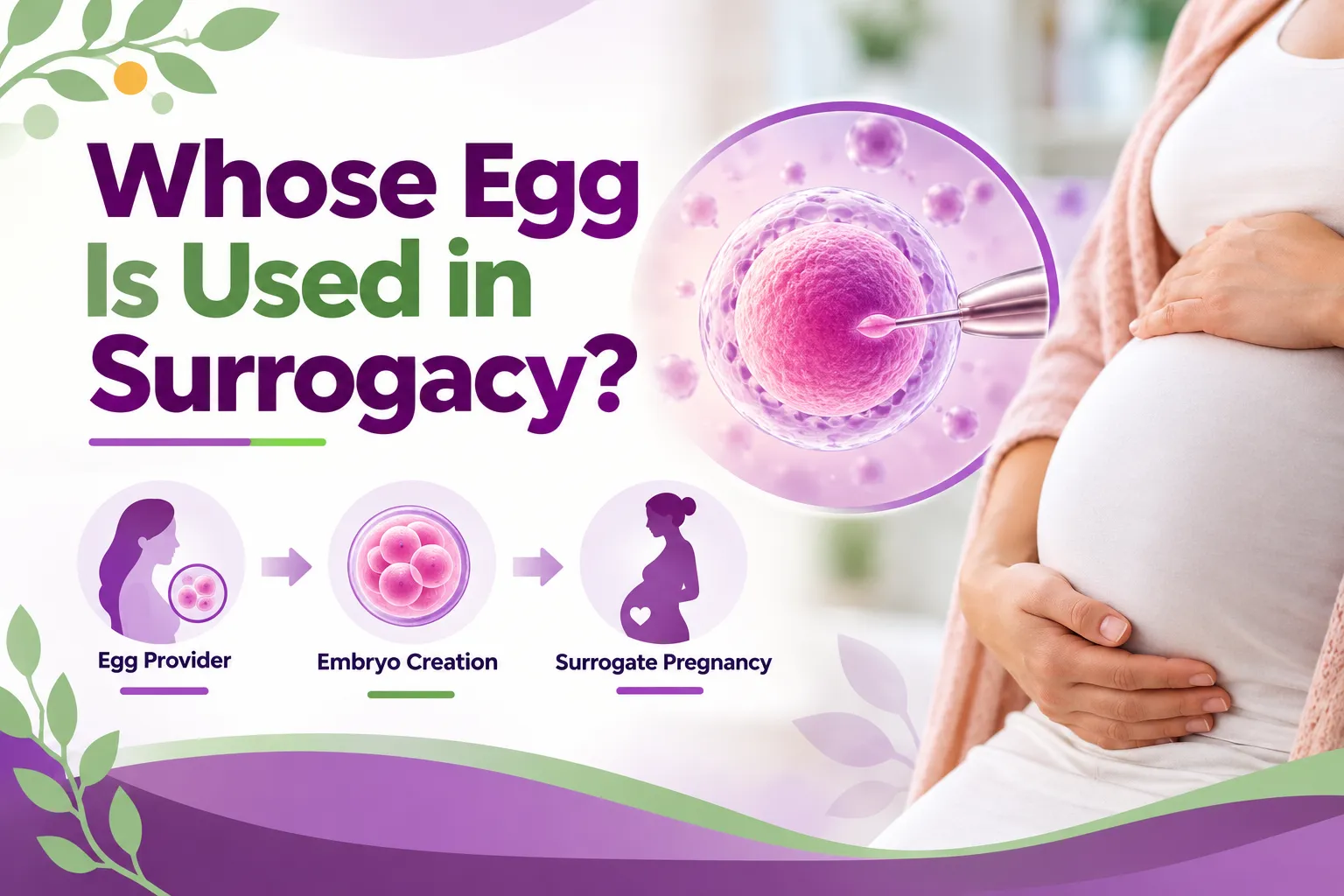
One of the most common questions intended parents ask about surrogacy is whose egg is used to create the baby. In modern surrogacy, the egg typically comes from either the intended mother or an egg donor, and never from the surrogate. The choice depends on medical circumstances and the applicable surrogacy laws in India.
In this blog, we will explain whose egg is used in surrogacy, how IVF works, whether the surrogate shares a genetic connection with the baby, and what Indian surrogacy laws permit.
Whose Egg Is Used in Surrogacy?
In gestational surrogacy, the egg typically comes from the intended mother, if medically suitable. The egg is fertilized with sperm through in vitro fertilization (IVF), and the resulting embryo is transferred into the surrogate’s uterus. If the intended mother cannot use her own eggs, alternative options may be considered, depending on the medical circumstances and applicable Indian surrogacy laws.
The surrogate carries the pregnancy but does not provide the egg in gestational surrogacy. Therefore, she does not share a genetic connection with the baby through the egg.
The choice of egg and sperm depends on the medical history and eligibility of the intended parents, as well as the legal requirements governing surrogacy in India.
Can the Intended Mother's Egg Be Used in Surrogacy?
Yes. In cases where the intended mother has viable eggs, she can use her eggs to form an embryo for the purposes of gestational surrogacy.
This process typically entails the following:
Ovarian Stimulation: Medication is taken to ensure that several mature eggs are formed in the ovary.
Egg Retrieval: The fertility doctor retrieves the eggs.
Fertilisation: The eggs are fertilised in the lab.
Embryo Transfer: The embryo is implanted in the uterus of the surrogate.
In cases where the intended mother's egg is used, it means that the child will get genetic material from her as well as the donor sperm. However, use of one's eggs does not ensure pregnancy.
Some of the considerations include age, egg quality, ovarian reserve, among others.
What If the Intended Mother Cannot Use Her Own Eggs?
Some women can suffer from the inability of low ovarian reserve, low-quality eggs, POI, or other problems with egg development. In that case, a fertility expert will help identify the problem and suggest available solutions.
In some countries, the use of donor eggs for those undergoing surrogacy may be possible. But it is important to remember that there are legal restrictions on the use of donor eggs for surrogacy in India. According to the 2024 amendments to the Surrogacy (Regulation) Rules, a District Medical Board can certify the need for the use of donor gametes in the intended couple only if the child has one gamete from the intended couple. Single women, who are either widows or divorcees, are required to use their eggs and donor sperm.
Hence, the availability of donor eggs in every surrogacy process cannot be considered a given.
Does a Surrogate Mother Use Her Own Eggs?
There are two kinds of surrogacy:
Gestational surrogacy: Here, the embryo is formed through IVF, with the egg provided either by the intended mother or some other legally acceptable source. The surrogate bears the baby without providing an egg of her own.
Traditional surrogacy: This involves the use of the surrogate’s own egg for formation of the pregnancy. Hence, she is genetically connected to the baby.
Thus, in gestational surrogacy, there is a clear distinction between genetics and the pregnancy-bearing function. In traditional surrogacy, there is no such legal framework accepted in India for surrogacy.
How Does IVF Work When Using a Surrogate Mother?
In IVF, the embryo is produced outside the body before being transferred into the uterus of the surrogate mother. The following steps outline the entire process involved.
Step 1: Fertility Assessment
The fertility expert examines the intended parents' health history and eligibility for surrogacy. The clinic advises on the possible treatment options that could work.
Step 2: Egg Harvesting and Fertilization
During egg harvesting from the intended mother, hormonal therapy encourages the ovaries to release eggs. They are then harvested and fertilized using sperm. This can be done using any method chosen for treatment.
Step 3: Embryo Growth
The growth of the embryos is monitored until the fertility expert chooses the one suitable for transfer.
Step 4: Embryo Transfer
Embryo transfer is done by inserting it into the uterus of the surrogate using a thin tube. A pregnancy test is conducted based on the guidelines provided by the fertility expert. Once there is a pregnancy, follow-up antenatal care should be done to monitor the condition of the surrogate mother and child.
Not all embryo transfers result in pregnancies, and the number of treatment cycles varies depending on the individual.
Whose Egg and Sperm Can Be Used for Surrogacy in India?
The source of the egg and the sperm will depend on the medical status of the intended parents and legal conditions. Under the Surrogacy (Regulation) Act of India in 2021 and subsequent amendments of its guidelines, the procedure is allowed in case prescribed medical and eligibility conditions are fulfilled.
For the intending couple, both gametes need to be taken from the intending couple. However, under the 2024 amendment, a donor gamete can be used in the case where the District Medical Board confirms that there is a need for this due to some medical condition, but in that case, at least one gamete needs to be from the intended couple. For eligible single women, whether divorced or widowed, their own egg and donor sperm should be used.
It implies that everyone is not allowed to use donor eggs or sperm. You need to check your eligibility, certifications required and options available under the current law before proceeding.
Will the Baby Look Like the Surrogate Mother?
As far as gestational surrogacy is concerned, the woman is not an egg donor, and thus, she does not pass her DNA along with the egg. The genetic makeup of the child will be determined by the individuals whose genes have contributed to the formation of the embryo.
The surrogate will provide the environment in which the child develops when pregnant. However, since she is not genetically related to the child, she cannot be regarded as a genetic mother.
These two relationships are different. This can be clearly explained by a fertility doctor.
Conclusion
While it comes to gestational surrogacy, the egg is taken from the intended mother herself, if there are no contraindications related to her eggs' condition. In some cases, other options for obtaining an egg could be considered, but there are some limitations for using a donor gamete as stated in Indian legislation. The surrogate does not provide her egg while carrying the pregnancy.
If you need any help regarding the process of surrogacy, Surrogacy Centre India will provide you with the necessary information.
Frequently Asked Questions
1. Whose egg is used in the case of surrogacy in India?
The egg from the intended mother is typically used in the case of gestational surrogacy. In certain legally accepted cases, the eggs of the donor are also allowed to be used.
2. Does a surrogate mother have any DNA relation with the child?
No. The surrogate does not have any DNA relation with the child because she does not contribute the egg.
3. Can a woman use her own eggs if she cannot carry a child?
Yes, in such a case, if the eggs of the woman are good enough, embryos can be created using her eggs through the process of IVF and can be placed inside the surrogate uterus.
4. What happens if the eggs from the intended mother are unsuitable for IVF?
This will be investigated to determine the reason and the possible course of action to take. The use of donor eggs can only be allowed where the rules on surrogacy permit.
5. Is traditional surrogacy legally allowed in India?
According to the Indian surrogacy regulations, surrogacy can only take place under certain conditions, and that involves gestational surrogacy. Traditional surrogacy cannot be performed since it involves the use of the surrogate's egg.
6. How is an embryo created through IVF for surrogacy?
The eggs are harvested and fertilized by the use of sperm in a lab. An embryo is then chosen and implanted in the surrogate’s uterus.